Mostrando las entradas para la consulta song ordenadas por fecha. Ordenar por relevancia Mostrar todas las entradas

sábado, 8 de noviembre de 2025

(Free) Stories based on songs/music videos to start the year

Resharing this post (originally from 2023) after talking with Claudia Elliot:


I am starting at a new school this year and I am very excited! 

I am thinking a lot about how to start the year off with my new students in a new setting that is pretty different from the one I have been at for the last 18 years. 

These are some of my goals for the first few weeks (and beyond really):

  • I want my students to LIKE and ENJOY Spanish class.
  • I want to ENGAGE students.
  • I want to give students LOTS of INPUT.
  • I want students to feel SUCCESSFUL.
  • I want students to ACQUIRE some language.
  • I want to have JOY in the classroom.
  • I want to create COMMUNITY.
  • I want students to understand that the GOAL of the class is to improve their COMMUNICATION skills in another language and to develop INTERCULTURAL COMPETENCE. 
  • I want my students to see and hear some people/voices from the Spanish speaking world #authres!

So, in addition to Card Talk and Write and Discuss for the first couple of weeks, I think I am going to teach a story based on a music video/song. I will be teaching Spanish 1 and Spanish 3, so I started sifting through my song/story resources and thought, "Geez! I have created and shared A LOT over the years!" (see "Archivo del blog" to the right). I am not sure which stories/songs I am going to use, but 
I thought I would share some FREE resources for others to use for the same reasons that I stated above. Some of these I sell on TPT, but I am kinda done with that, so I am just sharing them for free here.

If you feel like buying me a coffee, click here.


These could all be used with Novices:
These are a bit more advanced and could be used with Intermediates:

domingo, 16 de febrero de 2025

Debí tirar más fotos ~ Resources for an AP Unit

Last year, I used Bad Bunny's documentary "Aquí vive gente" in Spanish 3 and it went really well, so I was very excited when his new album came out and some of his songs explored the topic of gentrification and Puerto Rican culture even more!

So, I decided to create a unit for my AP class. The students and I have learned a TON! We are just finishing up this week and it has been a wonderful unit! We have hit all the AP themes and students are making some amazing connections (example: Bad Bunny --> Kendrick Lamar and Jacobo Morales --> Samuel L. Jackson - so cool!).

These are our Essential Questions:

  • ¿Por qué es considerada la música de Bad Bunny un acto de resistencia?
  • ¿Es la música de Bad Bunny una buena manera de educar, generar conciencia y luchar?
  • ¿Qué se puede aprender de la música y otras cosas producidas por Bad Bunny?
  • ¿Cuáles son algunos de los desafíos mundiales que enfrenta Puerto Rico?

We delved into all sorts of resources, including:

Here is the unit packet (with assessments). I am really looking forward to create for the Representación Visual assessment! 

Also, if you use Canvas, you can find the entire unit in the Commons:

Alternatively, if you just want to teach "Lo que le pasó a Hawaii", pages 6-12 here could be great! 


This is one of my favorite activities to really delve into the meaning of a song!


miércoles, 17 de abril de 2024

Creating songs to connect to units with AI - Suno

 Have you seen Suno.com yet? It is pretty wild. It is an AI site that will create short songs for you. Currently, my Spanish 3 classes are doing a unit around the movie Pachamama (thank you Arianne Dowd and Amanda Benavidez-Williams for your ideas and resources). So I put in this prompt, which includes vocabulary from the unit, the name of our school and the name of the town that the school is in.

A rap song about Pachamama and a small school in the village (vocabulary word in the movie) of Andover. The school called Proctor. Use the words aldea, cultiva, cuida, huaca  (vocabulary words in the movie) . Write it in very simple Spanish.

And it came up with two versions: one and two. These are the lyrics:


Students entered class and did this cloze and translation activity. Their reactions were: surprise and confusion. 

In Spanish 1, we are reading the book Tucán, so I entered this prompt:

Make a simple rap about a tucán from named Panchito with an injured beak. Oscar and Ana find him in a park. Oscar cries. Oscar's dad brings him to the animal rescue center. Put the song in Spanish.

And it came up with two versions: one and two. These are the lyrics:


My Spanish 1 students were equally surprised and confused. They did a similar cloze and translation activity. 

I highly recommend this site. It is a fantastic site to create short songs to accompany any unit!


domingo, 25 de febrero de 2024

Un cuento y una canción para Novices

 Have you seen this Diego Torres song? 

It came out a few months ago, but Carrie Toth just brought it back on my radar. She created some great activities for the song. You can find them here. 

But I wanted to something for my Spanish 1 students when they come back to class with three weeks away from Spanish (break + Project Period week), so I created this slideshow and some other activities. You can find them below or linked here and here. 


domingo, 21 de enero de 2024

Una canción de alegría y amistades de Ana Tijoux

 I LOVE Ana Tijoux and her music and have for a long time. 

My sixth blog post on this blog in 2013 (!) was about a unit that centered on her song "Shock" and that evolved tremendously to include the song "Cacerolazo". 

I also love to use "1977" to quickly teach students some numbers (just have students sing "mil novecientos setenta" many times and they won't stumble as much on some of those big numbers!)

Well, she is (finally back) with this amazing song and video:

The lyrics are so positive and joyful! I hope to use it soon, so I created a few activities to use with the video and song. You can see them here (for free).


domingo, 22 de octubre de 2023

Bad Bunny, gentrification and clothing as part of identity

Update 11/4/23: I added these questions about the documentary. If they are going to talk about it, they need that INPUT!

I LOVE Bad Bunny (not as much as Dr. Vanessa Díaz, the woman who created this amazing course, but a lot!) and have been a fan since his first album in 2018. But, I haven't used any of his songs because there is always something that makes me say, "Oh, nope, not this one!" If you feel the same way, but really want to teach an upper level class something about Bad Bunny, read on! If not, thanks for checking in :) 

I watched Bad Bunny's documentary "Aquí vive gente"(don't use the music video at the beginning in class) last year when it came out last year and really wanted to use it, but never got anything togetehr. But then, I found Carrie Toth's Gentrificación en Puerto Rico Huellas Freeform Spanish Mini Unit and Sub Plan, which is based on the documentary, so I combined that with some other things (see here) . I am very excited to teach about Bad Bunny and delve into these Essential Questions:

  • ¿Cómo afecta la vivienda la calidad de vida?
  • ¿Cómo puede usar su poder y su influencia una super-estrella para ayudar al mundo? 
  • ¿Cómo se puede equilibrar el crecimiento económico, la vivienda asequible, y la cultura de un lugar que pasa por la gentrificación?
  • ¿Cuáles son los impactos de la gentrificación en Puerto Rico?
  • As part of the unit, I finally found a song that I am going to use: "Yo visto así"! It does have one bad word in it, but I am going to just put #$%^ for that word. While it isn't my favorite (I definitely could not use my favorite in class!), it has an excellent message and I think it will resonate with students. This will be a great jumping off point to talk about clothing and identity. Also, some of the repeated structures are excellent ones to have in my students' brains: Lo que digan, no me importa, yo visto así, no me voy a cambiar.


    What else will they do in the unit?

    viernes, 20 de enero de 2023

    Shakira: chisme y un "diss track"

    Warning for some: Lots of chisme and a diss track are major parts of the Novice AND Intermediate resources shared below.


    The new Shakira song "SHAKIRA || BZRP Music Sessions #53" came out eight days ago and it is all over social media, so I am so excited to use it in class and hoping to have some good discussions about diss tracks in general and the amazing lyricism of Shakira.

    I was inspired by Anne Marie Chase's post on Facebook:

    After seeing that, Anne Marie and I started texting, learning, investigating and creating! For me, who was not up to date on the Shakira-Gerard Piqué relationship saga, there was a lot to learn. 

    I created some resources for Novices (doc here and presentation here). Anne Marie made an excellent game with the lyrics at the end.

     
    and here are some resources for Intermediates. This Intermediate version has multiple choice questions (getting prepped for AP).  The reading is significantly more advanced as it is an authentic article, with some support throughout.

    I also included a cloze and translation doc for both Novice and Intermediate. 

    After I posted, I saw this video from Dreaming Spanish and it explains a lot:


    Here is an Edpuzzle with the video above or you can find it here.


    miércoles, 3 de agosto de 2022

    Free Unit: Pescaíto

    This is the first unit in my Cultura y Civilización 

    (Spanish 4/5/6) course this year.

    It is a favorite and full of authentic resources, lots of activities and solid assessments. 

     Click here to access the resources 

    for this unit for FREE.


    Below is a post about this unit (from November of 2017)

    Have you seen the video Pescaíto by Carlos Vives?  

    I love it! I (and some of my Spanish 3 students) might be a bit obsessed with Carlos Vives lately! His music is really good and appropriate! 


    If you want to make it a song of the week, here is a doc with a cloze activity and a "translate some lines" activity for the song.

    I really wanted to comprehensify and extend this authentic resource. So, I created an entire story unit based around the song. The story is called "El Día Perfecto de Carlos Vives"and you can see it in the slideshow below. The words in italics are song lyrics and/or words from the song, so when students hear the song, they will already know many words. 

    The unit will help students to understand and communicate about what they and others would do. And they will also learn about Colombia a bit. Below is the slideshow (without links to the unit packet and cultural readings to extend the unit). If you want more, click here (link to TPT) and see below for what the unit includes. Click here if you want to make a copy of the slideshow and adapt it. If you feel like this is something useful, it saved you some time, and  you want to give back, click here.


    The unit packet has a ton of links and activities to comprehensify and extend the song/video! 

    Here are some more details about the unit, what it includes and a possible order for the unit. 

    This unit is for late Spanish 2 and above.  If your students have not heard of Carlos Vives (a famous Colombian singer), they might not be as enthusiastic about this unit. Before this unit, my students did two story units based on songs by him: “Robarte un beso” and “La Bicicleta”. Carlos Vives sings “La Bicicleta” with Shakira, so that might help to show your students how famous he is.

    This story unit focuses on exposing students to the conditional tense and acquiring some verbs in the conditional so that they are able to say what they and others would do.  

    In addition to a focus on the conditional, the unit is also wrapped around the song and video "Pescaíto" by Carlos Vives. The description of Carlos Vives' "día perfecto" is written using in the yo form (from Carlos Vives’ perspective) with vocabulary from the song and is illustrated with screenshots from the music video.

    There are also several cultural readings and/or activities that explore some of the cultural Products, Practices, and Perspectives in the video. These are all linked in the presentation and in the Pescaíto folder. These are the cultural readings:
    • Tras La Perla
    • Carlos Valderrama AKA El Pibe
    • Las Frutas de Colombia
    • El Restaurante en Pescaíto: Lulo
    • Carnaval en Pescaíto
    The presentation (linked in the unit packet with links to all readings, etc) will walk you through the unit. I have not divided this into days because I teach 85 minute classes and some people teach 45, 50, or 60, but here are some other suggestions for a possible order of the unit. 
    • Introduce the Essential Questions, Metas, and the Evaluaciones for the unit.
    • Briefly explain conditional tense (slide in presentation). I do not recommend focusing on this too much or having students take notes. They will acquire it through the repetition in the unit.
    • I no longer use vocabulary lists because I have found that students acquire the words that are most important to them throughout the unit. But there are some teachers and students who want and/or need a vocabulary list, so I have included two possible vocabulary pages at the end that you may want to use:
      • A blank vocabulary sheet where students can fill in words as they go through the unit. They could also make a Quizlet with those words.
      • A vocabulary sheet with keywords from the story. There is also a Quizlet with this vocabulary. A great quick way for students to become familiar with the words is Quizlet Live. I highly recommend it!!  That could be done before the story
    • Explain who Carlos Vives is and maybe show a video of his. "La Bicicleta" is a good one because Shakira is in it. (On that note, Arianne Dowd created a wonderful story and unit to go along with that song and you can find it here.)
    • Do the "Cuatro Esquinas" activity to activate what students would do on their "día perfecto".
    • Use the presentation to tell the story of "El Día Perfecto de Carlos Vives." 
    • Possibly use Flipgrid to do the Interpersonal Speaking evaluación with the personalized questions. OR just use those to have conversations with the class throughout.
    • Do the Quizlet Live activity for parte 1 to give more repetition and CI to students.
    • Continue the parte 2 of the story and do the same.
    • Do the cloze activity with the song. Listen and try to sing the song everyday throughout the unit.
    • Have students reread the story and illustrate it.
    • Do the translations from the song.
    • Do some of the cultural readings throughout the telling of the story. The readings are linked throughout the presentation.
    • Play "Agárralo" in pairs. Each pair has a pen/pencil/marker between them. I say cierto or falso sentences about the story. Students have to grab a pen/pencil/marker if the sentence is true. The first person to grab it, earns one point. If a student grabs it when I say a false statement, s/he loses two points. This is a fun game!
    • Have students do the matching activity about the cultural readings from the video.
    • Do the Quizizz activity as an in class activity, a homework, and/or a quiz. Students can do this activity more than once.
    • Play Backatcha. This game is a great way to get students speaking spontaneously! 
    • Have students do the Presentational Speaking Assessment - Prepare and present what they would do on their "día perfecto". This can be done in groups of four and recorded on Flipgrid. There is a description of this assignment and a rubric at the end of the packet.
    • Have students do the Presentational Writing Assessment - Identify the cultural Ps in the video "Pescaíto" and compare them to your own.
    Here are some possible Essential Questions, Metas para la unidad didáctica, and Evaluaciones:

    Preguntas Esenciales:
    • ¿Cuáles son las partes que más adoro de mi comunidad? ¿Por qué son importantes para mí?
    • ¿Cuáles son unos productos, prácticas, y perspectivas culturales que se ven el el video "Pescaíto"? 
    • ¿Cómo son similares y/o diferentes unos productos, prácticas, y perspectivas culturales que se ven el el video para "Pescaíto" con los míos?
    Metas:
    • I can talk about what I would and/or would not do on my "perfect day".
    • I can interpret a story about someone's perfect day.
    • I can compare what I would do on my "perfect day" to what someone else would do.
    • I can answer questions about what I would do on my perfect day.
    • I can identify and describe some cultural products, practices, and perspectives of the neighborhood Pescaíto in the city Santa Marta, Colombia.
    Evaluaciones:
    • Interpersonal Speaking (on Flipgrid): Answer personalized questions (sprinkled in the presentation) related to the story: "El día perfecto de Carlos Vives". OR This could also be Interpersonal Writing and students could write answers during the presentation.
    • Interpretive Reading/Listening: Answer questions about the story: "El día perfecto de Carlos Vives"
    • Presentational Speaking: Present to your grupito what your your perfect day would be like. Include pictures. (See description at end of packet.)
    • Cultural Comparisons/Connections: Identify the cultural Ps in the video "Pescaíto" and compare them to your own.

    sábado, 22 de enero de 2022

    Canción/Cuento de la semana: Melancólicos Anónimos

    It’s been a while since I have felt inspired to create anything and post here, but when I saw this song and heard this video, I thought “well, this song and video are perfect for a story script!” I will use this with my upper level classes (4/5 & AP) to start second semester. 

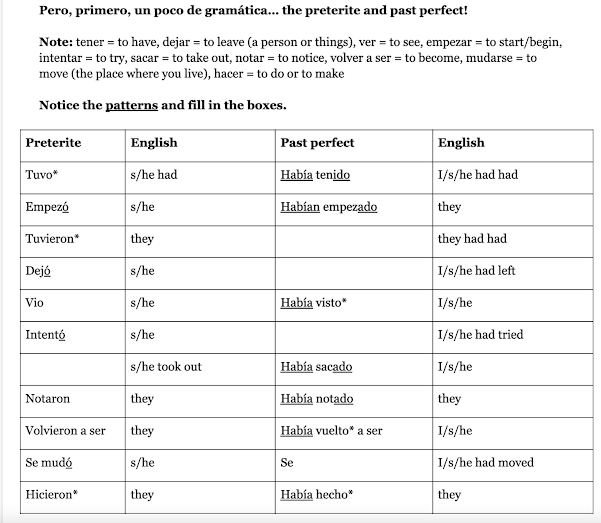
    My upper level students have really been wanting some grammar explanations. They want to better understand the patterns that they are noticing. So, to start students will do a quick grammar activity. My hope is that they will notice the patterns. This is the activity:

    Those past perfect verbs are structures that they will see in the story that they will read. 

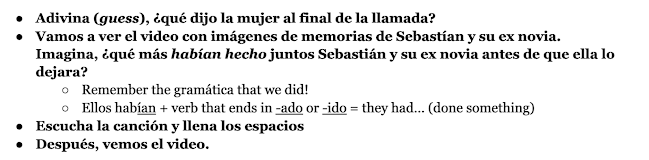
    After doing that quick grammar activity, we will read the story together. The story includes lines from the song and adaptations of lines from the song. As we read, we will either act out sections of the story, translate some sections or I will ask questions after reading sections. Then, students will do this:

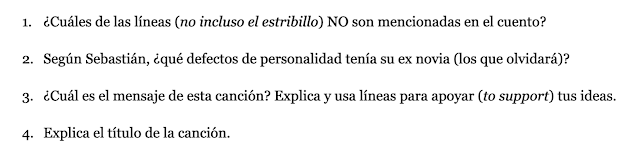
    And finally, after that, they will answer these questions:

    Here is the doc with the activities and the story.  Feel free to use and adapt, but please share back anything else that you create!


    miércoles, 13 de enero de 2021

    Canvas resources for the book "Minerva" and the movie "En el tiempo de las mariposas"

    I am currently teaching a unit that centers on the Fluency Matters book Minerva. After the book, we will watch the movie "En el tiempo de las mariposas"(available on Amazon). The movie is in English, but I give students lots of input with this slideshow created by Arianne Dowd (TONS of resources in her Film Guide). 

    I have taught this unit before, but without the book Minerva. The book has been the perfect, comprehensible addition! And the Teacher's Guide has a lot of extra readings and activities. Those + e-activities = TONS of comprehensible, engaging input.

    I am using Canvas this year (nd loving it!) and I am teaching in a hybrid schedule with two days each week that are totally asynchronous, so I have been Canvas-ifying lots of things. Some I can't share because they are from either Arianne's film guide or the Fluency Matters Teacher's Guide, but I am going to share a few things here. 

    First, I made a basic "intro the República Dominicana" activity with this video. Students have to watch, write down what they hear and then do a matching activity. Here is the Canvas quiz.

    I also took the text from Arianne's slideshow and created three Canvas quizzes (autograded!). Here is a video to show what they look like:


    And here are the links to those in the Commons:

    I also created two Canvas quizzes for two songs. One is for the song "Tú me dejaste de querer" (it combines bachata and flamenco). It is just a good song and doesn't really necessarily relate to the book. Here is a link to that in the Commons. 

    The other song is "Antipatriarca" by Ana Tijoux. Below is a video that explains that Canvas quiz. And here is the link to the quiz in the Commons. 


    sábado, 3 de octubre de 2020

    Bingo Musical + Canvas + Remote Day (or in class)

    Update 3/1/21: Here is a Bingo Muscial for March Madness (day 3). And here are two more Selena songs (we are reading the reader Selena right now!): Como la flor and Bidi Bidi Bom Bom

    Whoa! What a school year so far... and somehow I am only three weeks in (with students)!

    My school has a hybrid schedule with two cohorts. 
    • Cohort A is in school Monday and Tuesday and does asynchronous work on Thursday and Friday. 
    • Cohort B does asynchronous work on Monday and Tuesday and is in school on Thursday and Friday. 
    • On Wednesdays, we are all remote and we meet with our classes  - both cohorts at the same time - for 30 minutes. Then, they have 30(ish) minutes of work to do after. 
    • Cohort B will always be two days behind cohort A... which makes our Wednesdays a bit tricky!
    Since, cohort B is two days behind, we can't "continue with our unit" on Wednesdays.

    So, thanks to Samara Spielberg and Bethanie Drew, I have an excellent solution: Bingo Musical! 

    NOTE: This something I would actually use in ANY teaching situation - normal - remote - hybrid - bla bla.

    Here is an example:

    So, basically we Meet (can't use Zoom in my district anymore) and play two rounds of Bingo Musical. Students watch and listen to the music video twice. They type "bingo" in the chat as they win... there are lots of winners.

    Then, they go and do a cloze (auto-graded!) activity, a translation (auto-graded!) activity, and give their opinion in Canvas. 

    Here is why I love this activity:
    • We are definitely hitting this standard --> Communities: Lifelong Learning: Learners set goals and reflect on their progress in using languages for enjoyment, enrichment, and advancement.
    • Also, students are seeing and hearing an authentic resource from the Spanish speaking world. They are seeing a ton of cultural products, practices, and perspectives.
    • It is fun! 
    • They are getting to translate the song in an easy way (see video above).
    • It is auto graded!
    • It solves my "What the heck to I do with the whole group on Wednesdays when half of them are a day behind the other half?!"
    Below are the five Bingo Musical slideshows that I have made so far. Feel free to make copies and adapt. The links to the Canvas "Quizzes" are also in the slideshows.


    jueves, 27 de agosto de 2020

    Song/Story of the week: Tan bien

    Update 8/30/21: There are already quite a few links to prepare, tell and review this story (a slideshow, 3 Quizlets, 2 Textivates, and a prediction activity), but I just updated the activities in the doc to include the following:

    • Part 1a: Listen and draw
    • Part 1b: Listen, look and id pic
    • Simplified cloze activity for the song
    Note: For this to work best, don't show the entire video until they know the story and have made predictions! 

     I used this catchy song in January of 2019 at the end of my Cultura y Civilización course.


    I wrote a story to go along with it and incorporated lots of structures and vocabulary that are in the song lyrics (arrepentido, rechazar, enterarse, olvidar, luce, lastimar). That story is good, but a bit too advanced for my students in September! 

    So, I wrote a simplified version of the story. It is in the present tense with basic structures (for the start of level 3+). You can find the text version here and the presentation here. There is also a cloze and translation activity for the song lyrics in the doc. Feel free to make copies and adapt! But, if you do, PLEASE share any enhancements or improvements that you make!


    I also created these:

    I start school next week, but students don't start until the 14th. We have a hybrid model with two cohorts. One going to school on M/T and the other going on Th/F. Wednesday is remote for all with synchronous lessons. Some of these song/story activities will be done face to face, some on Wednesdays on Zoom/Meet, and some asynchronously. 


    miércoles, 22 de julio de 2020

    Breakout Dictation... and another PD offering


    I have presented some PD in the last couple of months and one thing that teachers really like is Zoom Breakout Rooms (I hope Google Meet has them soon!).

    So, I wanted to share something that I have done with teachers: Breakout Dictations (see below or click here).
    Decided not to this PD now... Coming soon: A three hour workshop called "Story/Song of the Week(s): Remote Version". This workshop will be in mid-late August and will be three hour Zoom session spread out over four hours. Details coming soon!

    domingo, 3 de mayo de 2020

    Oldie but goodie for ONLINE Canción/Cuento de la Semana: Puebla

    I created a unit with that song as the base and I am so looking forward to using it next year. There are lots of excellent authentic resources related to a legend and food in there, but for now, I am sharing because there are parts of the unit that could be used for online learning.

    Here are the resources that could be used online:

    domingo, 19 de abril de 2020

    Canción/Cuento de la Semana... in EASY past tense


    At the beginning of this year, I used that video as story/song of the year with my Spanish 1 class. They really liked the song and it was an easy story.

    Right now, I have Spanish 2 and I have been exposing them to the past tense for a while now.

    So, to give them some more input with the past tense and high frequency structures/vocabulario, I re-wrote that Spanish 1 story and put it in the past tense. 

    During this online learning period, I am using the Fluency Matters e-course El Ekeko with my Spanish 2 class, but they also do a story/song of the week each week. 

    They follow the same basic pattern. Here is an example of what they will do with this song story:
    If you are looking for another easy song/story in the past tense, check out this one:


    viernes, 10 de abril de 2020

    ¿Qué hiciste hoy?

    Looking to talk to your students and see what they have been up to being in their houses all day long?

    Looking to give some input with a catchy song and familiar tune?

    Looking to give some input with the preterite (and some chores)?

    Then, check out the video(s) and slideshow below.

    When I saw this song (posted on Zambombazo and shared by @SraPenarandaMMS
    on Twitter), I thought it would be a really good one to use in "class". 

    And then, I found this version, which has a man doing all the things he mentions in the song. 
    So, I made up this slideshow (click here if you want to make a copy) to use before we listen to the song (or before they even know there is a song):

    And here are the full lyrics.

    Extra credit idea: Remake this video at your house!

    domingo, 5 de abril de 2020

    Idea for extra credit and/or enrichment: Authentic Listening and Current Events

    Just a little post to share something I am giving to my students this week:
    Extra Credit: Authentic listening and current events (doc here)
    • Watch and listen to one (or more) of these songs from the Spanish speaking world.
    • Write up a quick little response about what you saw and heard and your opinion about it.
    • This can be in Spanish, Spanglish and/or English. 
    • Are these songs/videos similar to anything that you have seen in our culture?
    • OR DANCE! See the video 2b and 4b.
    • Note: There are THREE different songs called "Quédate en casa" (Stay home).

    2b) Argentina/Spain - Resistiré (I will resist) - DANCE video
    3) Spain - Quédate en casa (Stay home) Students probably won't know these people,
    but they are famous people from Spain. Although, they might recognize one (Álvaro Soler).